. . telling stories from 25+ years of living and travelling in Turkey; some are informative, some cautionary and some are downright hilarious - all of them are interesting. There's never a dull moment.
Alan is the founder of the Okçular Book Project and author of 2 outstanding and best-selling books about Okçular Village; 'Okçular Village - a Guide' and 'Backways and Trackways' a walking and cycling guide to the area including Kösten and Ölemez Mountains. All of the money raised by the project helps his village community. More info: bofs.blog surmanfenn@gmail.com
This is one of the really good things about blogging; we can get to bore the pants off everyone and, unless we happen to be a ‘stats freak’, never be aware of the yawns and glazed eyes! Bliss!
So, yes, this is about a couple of back-to-back days of gentle wandering with a few impressions of what being a ‘Boffer’ in Okçular is all about. Well, not exactly ‘all’ because this time of year there are plenty of chores to be done like pruning trees and pressure-washing the fossils ferns embedded in the Muğla stone slabs in the yard.
Anyway, enough of all that. Are you sitting comfortably? Then I’ll begin . .
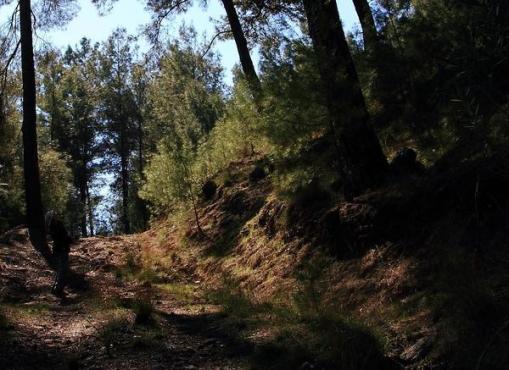
Once upon a time, by the edge of the forest, there lived this old geezer and his missus. They felt a great affinity with the trees and flowers and creatures of the woods and loved to go a-wandering, communing with Mother Nature and her off-spring. They whispered to the trees and the trees whispered back . .
J whispering endearments
. . even the elemental spirits, hidden from the eyes of the sceptical, would appear to them from time to time.
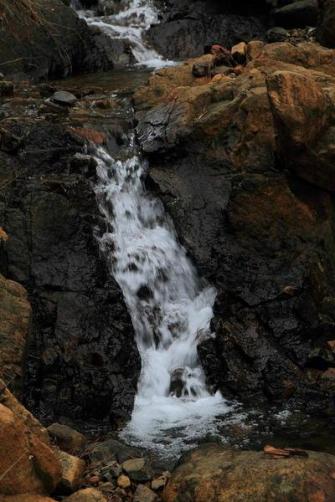
the Water Spirit – can you see it?
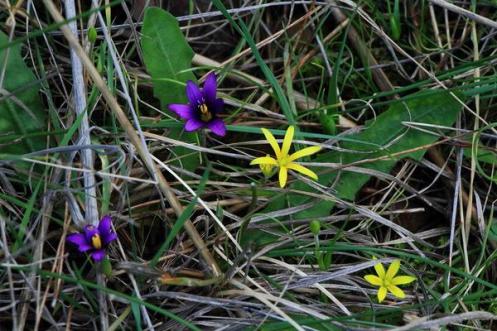
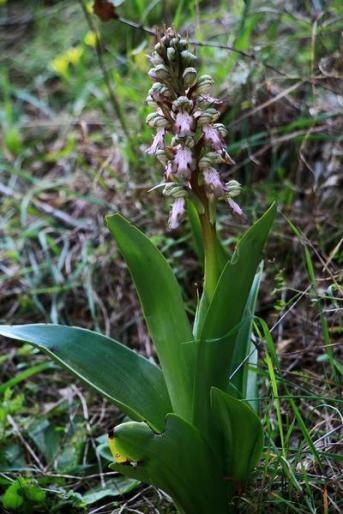
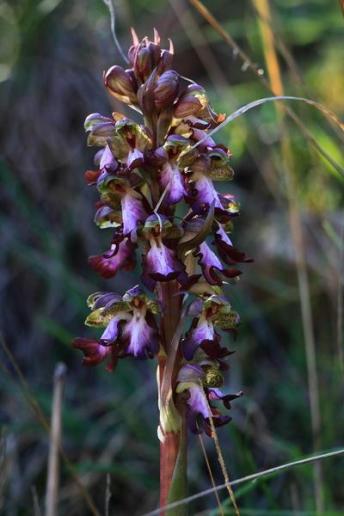
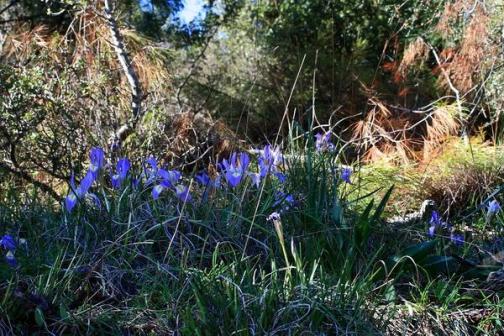
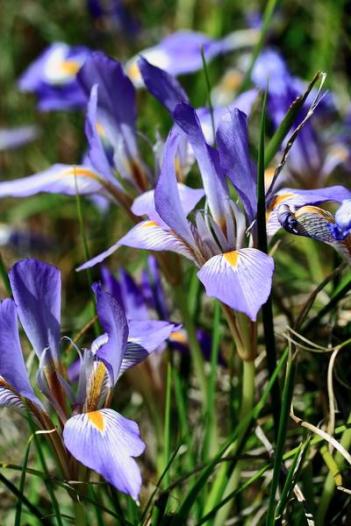
Spring has sprung – after a cold snap and a late start the buds are budding and the flowers are flowing and flowers are – well – flowering! Come and wander, it’ll do your spirit good!
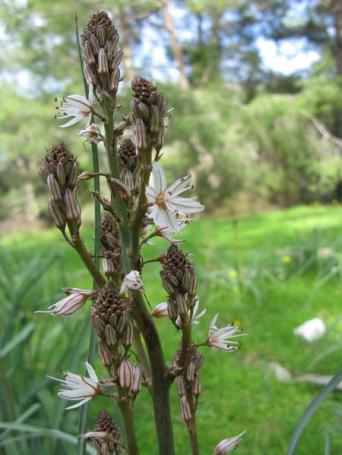
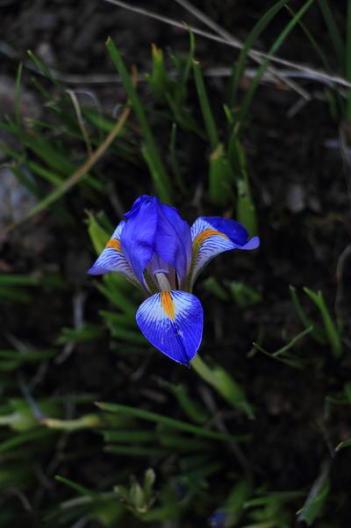
Asphdelus aestivus – Asphodels are everywhereRomulea tempskyana Sand Crocus and Gagea arvensisGiant Orchid (pale coloured from lower slopes). . and this dark beauty from higher up the mountainthe inevitable Algerian Iris – they are everywhere
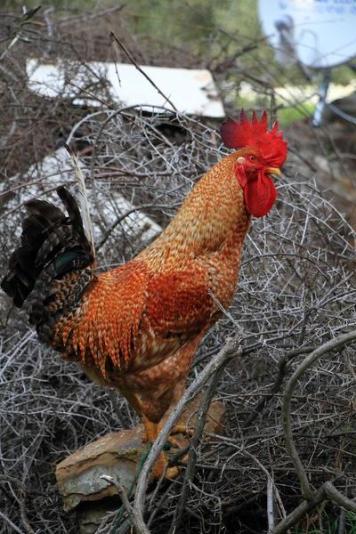
some with the richest of colourearly stages of Coq au Vin
We thought he was a bold fellow until we noticed that he was securely tied in place. Now, a Southerner like me can make a joke here about Yorkshireites and their funny accents and title this as ‘Chicken in t’ wine’. However J, who is well known as a regional accent buff at Pedant’s Corner, Private Eye, has spotted this over my shoulder and insisted that I insert the following correction which is a direct copy from that illustrious organ:
Dear Ed,
Pedantry Corner:
To Farmer Geddon (Eye 1289), Peter Sharples (Eye 1290) and Charles Warwick (Eye 1291) I am obliged to say “Nay lad!”
Being South Yorkshire born and bred, (although now away many decades), in our area the ‘the’ was never a ‘t’ at all. The ‘the’ was and is an almost imperceptible hiatus between two words. The nearest I can come to writing it is “trouble at ‘ mill” – the ‘ in place of the three missing letters of ‘the’. Or, a longer example, “Down ‘ Wicker weer ‘ watter runs ovver ‘ weir.” (three missing thes)
The important thing to remember is that to really represent the accent accurately you must definitely sound these examples out loud wherever you are.
I especially fondly recall ” ‘t i’n’t in ‘ tin” (only one the here).
Yours for ‘ society o’ ‘ preservation o’ regional accents,
Janet Surman.
Last post I’d rambled on about various trips of a lifetime, one of which included Venezuela, and that got me digging out some of the photos from that little foray. Clicking through them revived memories of sights and smells, particularly from our exploration of Los Llanos (Loz Yanos) with naturalist and all-round nut-case Roger Manrique aka ‘Croc Roger’. Now, this blog is supposed to be about living in Turkey but as our trip started here I decided to stretch a point and share some moments with you.
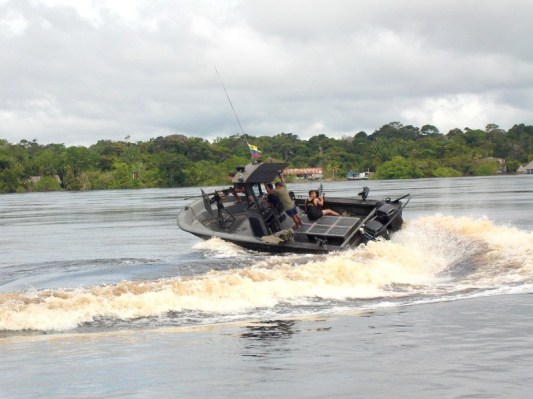
Los Llanos is a vast, semi-flat wetland area in Barinas Province. It’s criss-crossed by countless rivers that all feed into the mighty Orinoco River. Crossing one of the numerous bridges en-route to our base I was surprised (although I shouldn’t have been as the largest known oil reserves in the world are here) to be driving by a Venezuelan Navy base.
Due to flooding in the wet season all of the roads are raised up on dykes that have been constructed by digging out along each side. This means that during the dry part of the year great pools remain that attract the wildlife from all around. Observing at close quarters is ridiculously easy and when you add in river trips to seek out everything from anaconda to caiman to electric eels to iguana to piranha to giant river otters to pink dolphins to . .
three different Ibis in one shot
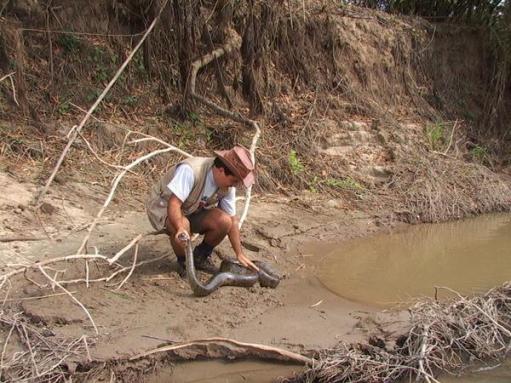
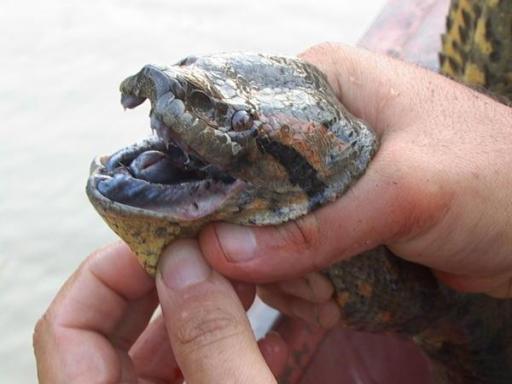
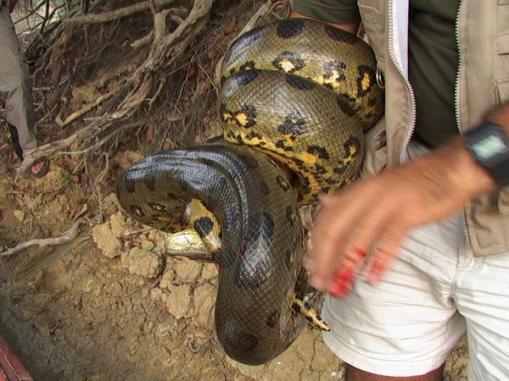
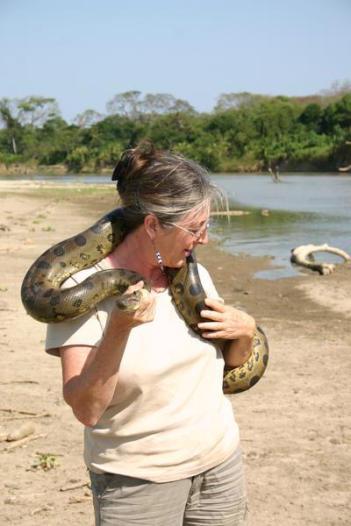
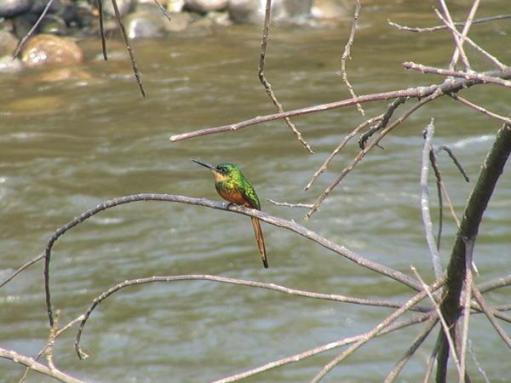
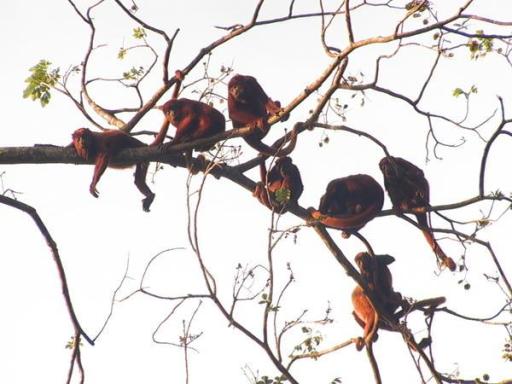
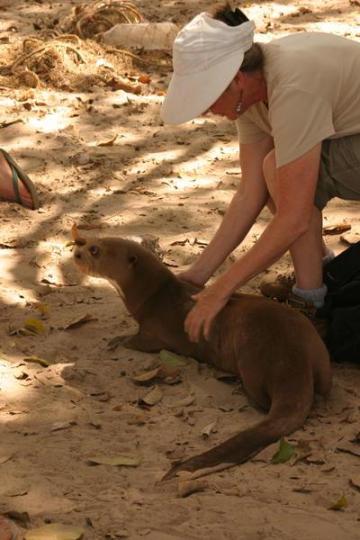
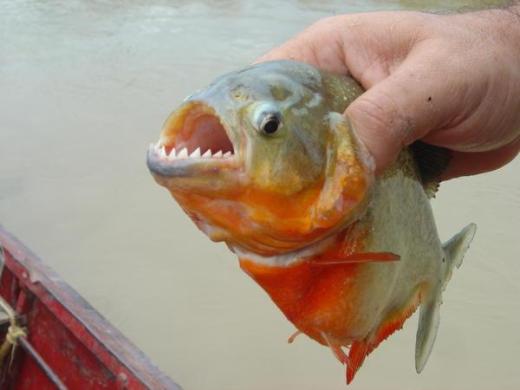
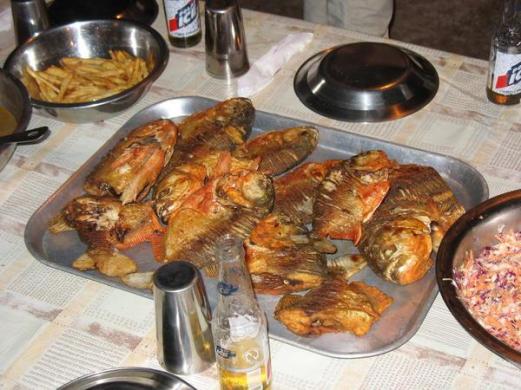
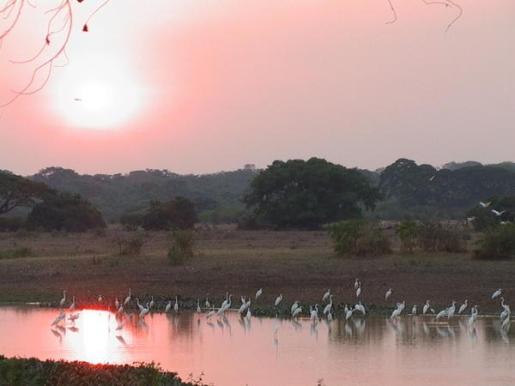
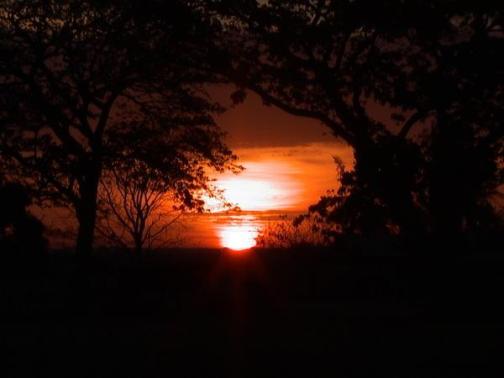
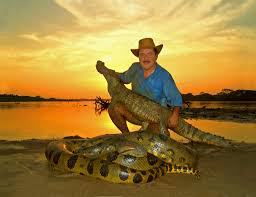
What follows is a glimpse of what is in store for those intrepid wanderers who don’t take the plunge like Roger and stay sensible and fairly dry with fingers and toes tucked well in! Meet Pepe, an orphan Giant River Otter that was adopted by a local – he’s loving and inquisitive; fishing piranha for supper; getting wrapped around a male anaconda; three different coloured ibis in one shot and sunsets to die for!
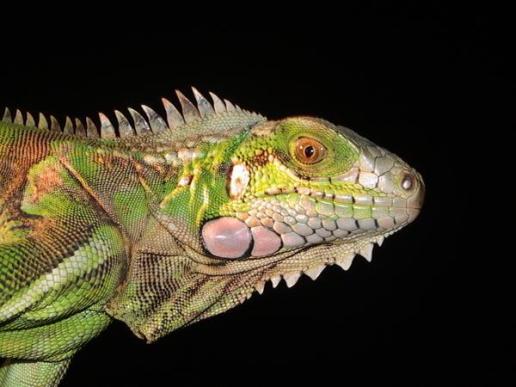
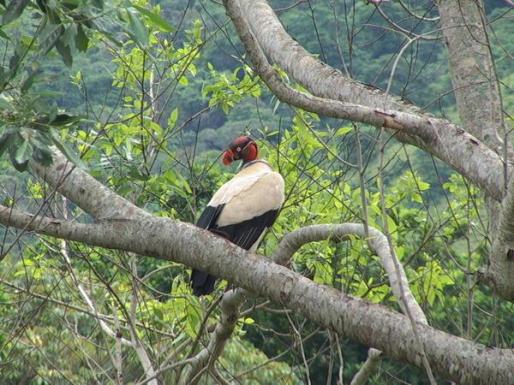
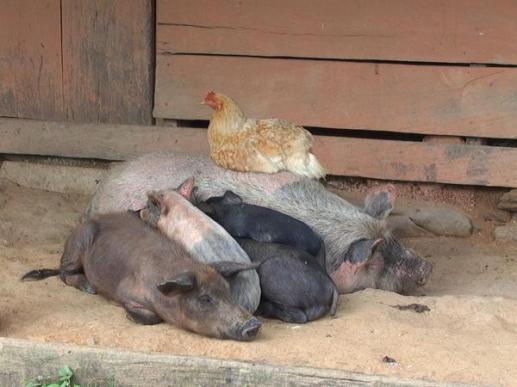
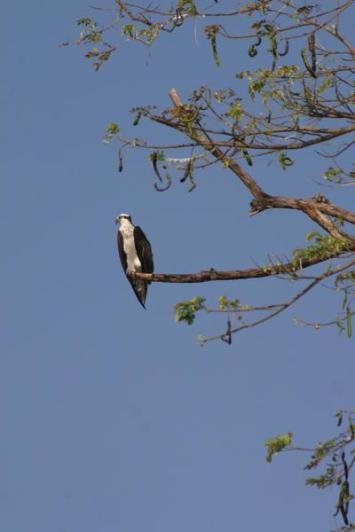
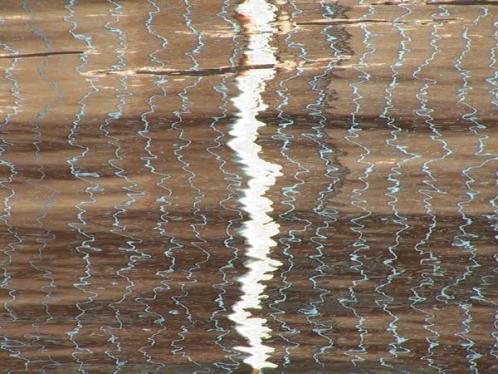
Roger catches young male AnacondaRoger shows Anaconda’s teethAnaconda demonstrates use of teeth!J demonstrates her skill at snake charmingEmerald KingfisherHowler Monkeys (they really do!)J with ‘Pepe’ a young Giant River OtterPiranha – this time . .I get to eat you for supper!. . as the sun goes down. . the Iguana come outas handsome a vulture as I’ve ever seendomesticated bliss!a fishing eagleAnteater at duskbeautiful reflections on waterGoodnight!
Alan, once upon a time up the Orinoco without a paddle!
J and I love the odd ‘trip-of-a-lifetime’ every now and again! Since moving here to Turkey we’ve wandered off on the Trans-Mongolian Railway from Moscow to Beijing; (salvaged from Archers of Okçular first posted February 2014)
With many, many, many days spent rocking across the steppes in a daze (I never realised there were so many different types/flavours of vodka) there would come times when one needed a shower. Our babushka would hold up five fingers, snatch the dollars and direct you into her cubicle where sat one of these . .
Your $5 bought you the contents of the samovar, a bit of rubber hose for the tap and a squat over the drain-hole in the corner – oh, and she kept guard in the entrance way and held your soap if required!
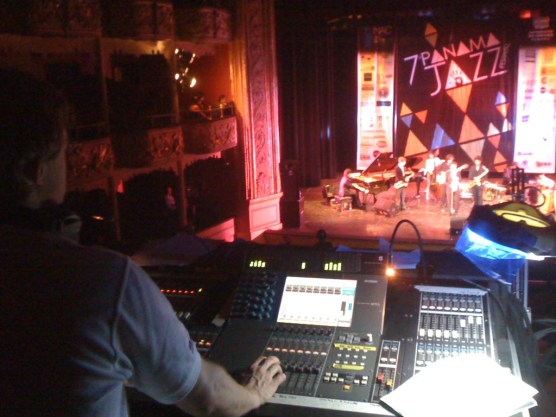
We’ve taken in the Panama Jazz Festival for no better reason than the delightful local pianist Danilo Perez invited us. We were also treated to passes that admitted us to everything (including many a meal). Danilo is the founder and the festival supports young musicians from poor circumstances with tuition, instruments and scholarships to Berkeley School of Music. Add to the glorious music some wonderful exploration trips along the canal and to beaches and islands and the vultures at sunset and you have a perfect encore.
our son Ben, sound engineer of choice for many big names and venues, at the board in the beautiful old National Opera House in Panama City – on stage are some of the young and very talented musicians enjoying their very own gig
From Panama we wandered across to take in some of the revolutionary and ecological joys of Venezuela. In Caracas we met with Chavistas and the amazing Presidential Guards from Chavez’ old regiment who reversed the US instigated coup against him in days! In Merida up in the Andes we rode to the top of the longest and highest cable-car in the world whilst stubbornly refusing the available oxygen bottle and we got an OAP discount into the bargain! Then we found local field biologist, guide and artist Roger Manrique aka Croc Roger who led us exploring the backwaters of the mighty Orinoco River where we wrestled with Anacondas and Iguanas (this is true), fished piranha for dinner (this is also true) and saw and photographed more wildlife than you could believe existed! We also spent a few days on the tropical paradise islands of Los Roques where, amongst other things, I was able to ogle the amazing creations that plastic surgeons can achieve in exchange for a lot of dosh – you are left wondering what keeps them up!
. . and now? We are in the early stages of organising a tour of the Glories of Persia – we are (visas and other things being equal) going to be wandering around in Iran for 16 days in April. We’ll be using as much local transport, buses, trains and the like as we can in order to be in contact with ‘ordinary’ Iranians.
Originally we’d hoped to travel by train from Istanbul to Tehran but I think a Turkish Airlines flight is going to simplify the bureaucracy. Then it’s off to places like Esfahan; Shiraz; Bam; Yadz and even Mashad way over in the east of the country before wandering back to Tehran via the Aborz Mountains just south of the Caspian Sea. So much history and culture and food and people to learn about before we get too cranky and creaky – wish us luck with officialdom!
J and I are not just tolerant of having wildlife around, we positively encourage it – all of it! The odd snake in the toilet or under the washing machine does not result in panicky shrieking and rushing around in circles. (OK, we didn’t actually have a python in the toilet but there was a fair-sized black Whip Snake) That said, there was an occasion a few years back when I sat on a dozing hornet whilst getting into bed that resulted in all of the above plus some amazingly accurate usage of Anglo-Saxon expletives and a carpet slipper!
No, generally speaking, we go out of our way to provide suitable, upmarket accommodation and restaurant facilities to satisfy regulars and passing trade alike. So, we were a bit annoyed that some vandal or other was bent on trashing one of our bespoke fat-feeders for the birds. We were regularly finding it busted off its mounting, hurled around the garden and generally well chewed up. We had a fair idea which family of delinquents was responsible but, catching them at it was never going to be easy because they are clever, resourceful and very, very cautious.
In the end, patience and technology paid off with the little tow-rag caught infra-red handed . .
There’s a lot more to Konya than Whirling Dervishes, the Mevlana Museum and the haunting sound of the ney. Konya has been around for a while and in that time it has hosted everyone from Neolithic hunter-gatherers and Hittites, to various Greeks, Romans and Persians. And then the Seljuk Turks rolled in and had their day before getting rolled up by the marauding Mongol hordes around 1243.
The Seljuk Sultanate of Rum (as in Rome and not Capt. Morgan) was a pretty successful set up in its day. Covering much of present day Anatolia it traded across the Mediterranean basin and Middle East. It was powerful and wealthy enough to battle the Crusaders and foster art and architecture on the grand scale and Konya was its principle city for much of its existence.
So, where is this leading? J and I had been to the fabulous Neolithic site at Çatalhöyük and so a visit to Konya’s Archaeological Museum to see some of the stuff that had been excavated was a must. The museum is not far from the centre and is in the type of area that we love to wander around – a bit run down and lived in!
As we got close to the museum we were delighted to discover one of the unsung treasures of Konya – the restored Sahib Ata Camii and medrese. Named for one of the greatest builders of the Seljuk Turkish Empire; the Vezir Sahip-I Ata Fahrettin Ali.
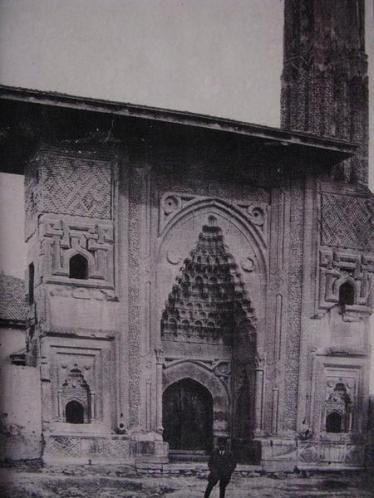
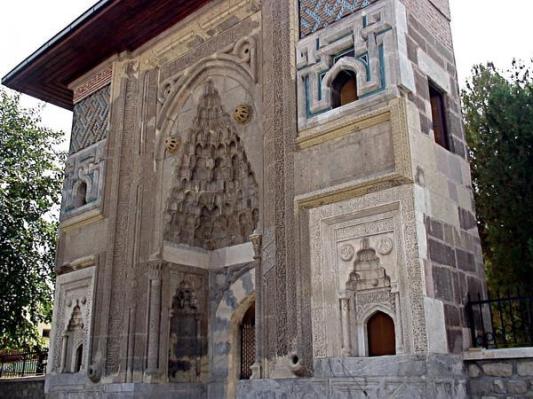
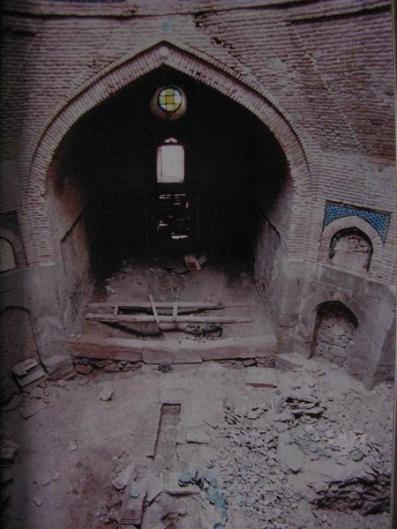
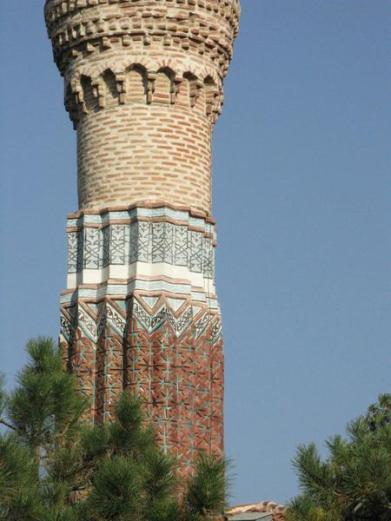
Once this was a vast complex but only parts have survived to present times. What remains of the mosque is now simple and beautiful and lives on in everyday use. A fabulous restoration of the monumental gate with its stunning minaret and the medrese took place during 2006-7 with the medrese serving as a museum of Seljuk arts. The hamam and tekke or dervish hall are undergoing restoration.
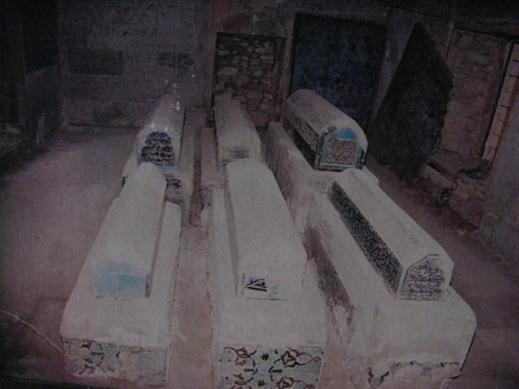
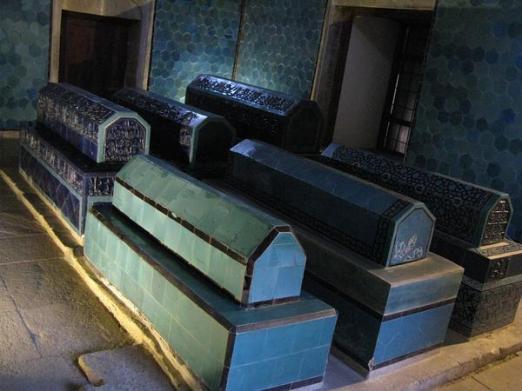
There is no better way to show you the worth and wonder of this place than to show you some before and after pictures – it’s one for your bucket list! First, a couple from the archive of that amazing woman Gertrude Bell:
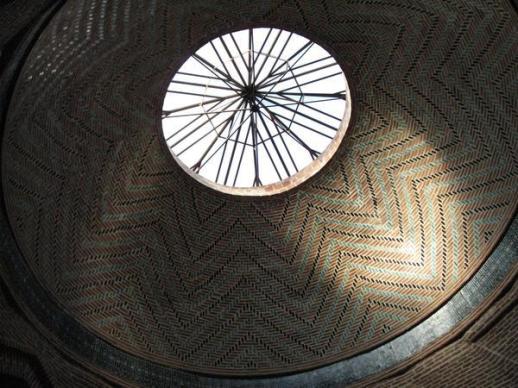
the complex and that part of Konya as it was in Bell’s timethe monumental entrance and minaret before . .. . and afterinside the medrese before. . and afterthe turbe of Sahip Ata and his family before restoration . .. and aftermedrese dome
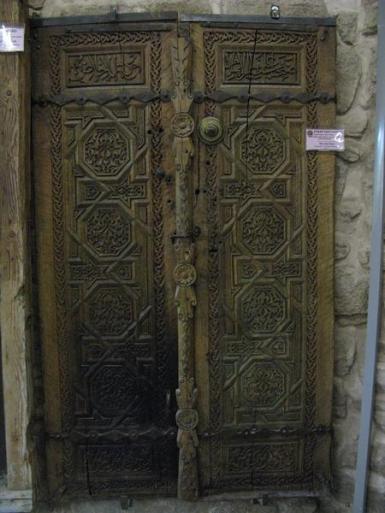
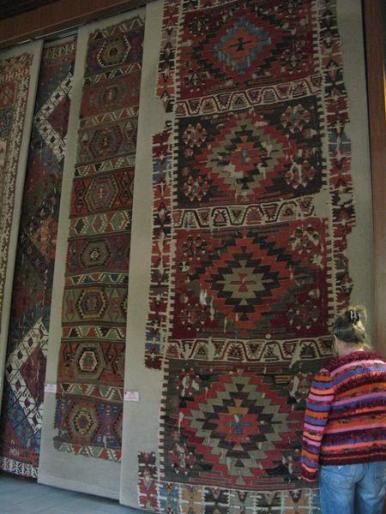
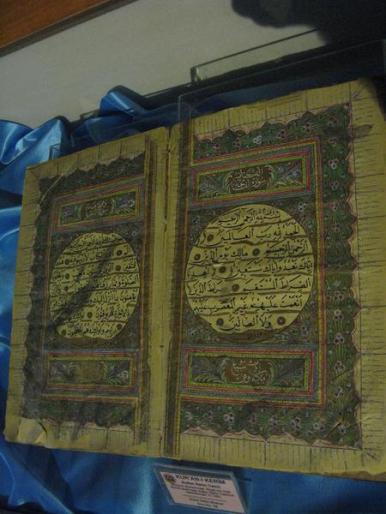
There is a collection of beautiful artifacts that will delight your eye . .
. . doors, and . .carpets, and . .beautiful, illuminated Qur’an’sthe minaret that stands by the monumental entrance and much more
Finally, a link to a 3D view around the Monumental Entrance to the Sahip Ata Camii and website in English.
Other people’s kit is always interesting – I’d go further and say that other people’s anything is always more interesting! Ever sat in a restaurant watching other diners and noticed that their eyes always seem to spend more time looking at what those around them have on their plates? I know I do – I’m always thinking to myself that I wished I’d ordered what they have – it looks nicer and there’s more of it!
The same holds true for blokes using urinals – but that’s another story! (salvaged from ‘Archers of Okçular’ first posted in November 2013)
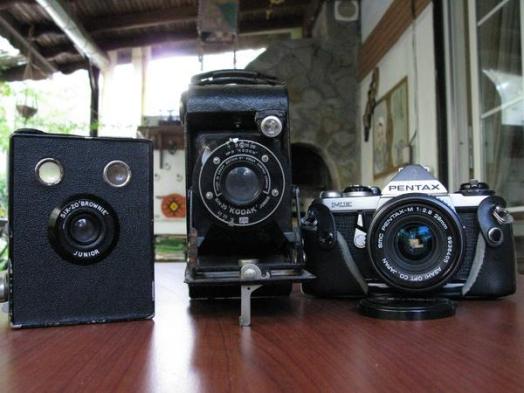
Enough of all that, back to the subject in hand. I’ve been asked lots of times about the camera gear I use and, as I use it rather poorly, I’ve often wondered why. There’s no denying that I get a lot of fun out of the kit and the more buttons and functions it has the greater the fun! I started with a little plastic thingy with a fold-out viewfinder when I was eleven, and over the years I’ve played around with a Kodak ‘Box Brownie’ and a Kodak Six-20 ‘Kodon’ bellows. There was also a Yashica Twin-lens reflex that was followed by the brilliant Pentax M. Many of you know how difficult I find it to part with anything so, much to J’s despair, I still have the ‘Brownie’, the ‘Kodon’ and the Pentax!
one day they might be worth a small fortune!
My first digital was a very cheap Konica-Minolta Dimage that fell to bits within a short period and led me to my first Canon – their original entry level 300D. Against all my hoarding instincts that kit is on its way to UK to a young wildlife enthusiast – I hope he shares with his sister and becomes a better photographer than I’ll ever be. I also hope it leads on to a lifetime of fun and interest.
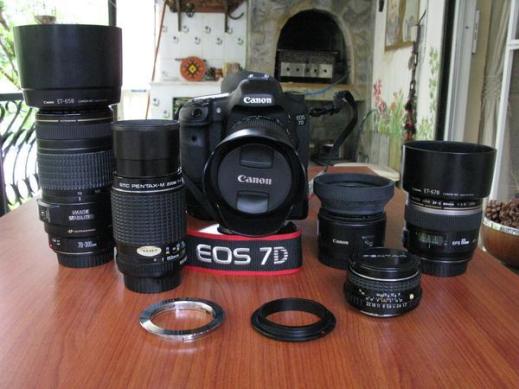
My present kit is shown below – an EOS 7D; EF 70-300mm; EF 50mm 1.8; EF-S 60mm macro; EF-S 18-135mm STM. I love the flexibility it offers and I know that good kit doesn’t make a good photographer.
the kit including ‘legacy’ lenses and adaptor rings
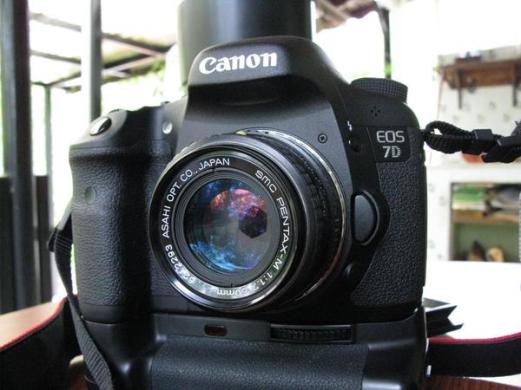
That said, I love messing around and experimenting and part of that fun has been to modify my old Pentax lenses, which are wonderful bits of glass, and using reversing and adaptor rings I’m able to use them in a conventional way sans any auto-focus (or auto anything).
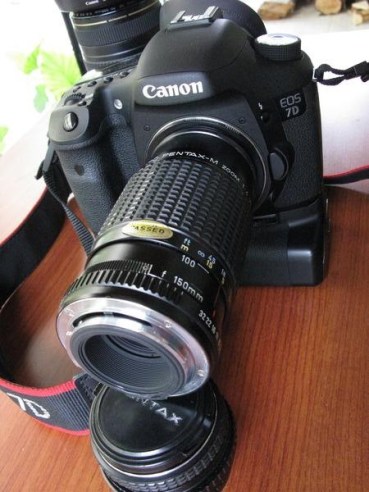
fitted with Pentax 50mm f1.7 a beautiful bit of glasspentax 150mm zoom lens reverse mounted and acting as a super macro
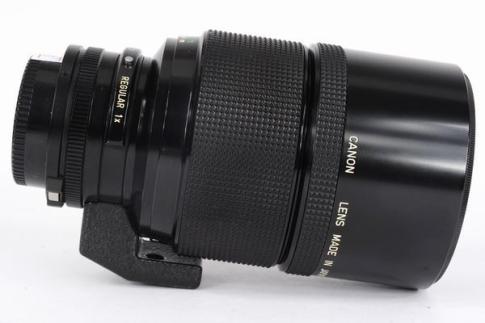
By reversing the 150mm zoom it becomes a super-macro lens which is magic to play with. Sitting on the sidelines in the UK whilst I figure out how to get it to Turkey is another ‘legacy’ lens. Built in 1964 for the Tokyo Olympics (and a now defunct model of camera) it is a 500mm Reflex (or mirror) lens. it is said to be the best of its kind ever made – that said it will never match the performance of a modern EF lens but at about 5% of the price never mind the quality, feel the width!!
It’s in pristine condition and is complete with its original leather case. I have had a special mount built with optics that will allow it to fit my EOS and focus from very close to infinity! Now that really is going to be fun!
And the ‘Flash, Bang, Wallop’ bit? Take a few minutes to enjoy this clip . .
J and I went off wandering again this past week – the Prime Directive was to visit Çatalhöyük near Konya and then tuck in a few other goodies as time and circumstance allowed. We both thought that the on-going excavation of this astonishing Bronze Age settlement was brilliant. I, for one, was fired up and set about trying to transfer that fire into a blog post that just might convey something of what we had seen. I was minutes away from posting when everything vanished; text, photos – the lot. There was nothing on the server where you would have expected the last auto-save to be and the auto back-up on my computer was blank! I have never experienced anything like it. Disheartened was not the word!
Anyway, enough of all that – let’s see if I can’t recapture at least some of that enthusiasm.
Picture, if you can, the vast flatlands of central Anatolia, dry and brown after the burning heat of summer. This land is the ‘breadbasket’ of Turkey, in some ways similar to the North American prairie or the steppes of Ukraine. Out of this flatness a mound some 21 metres high rises, topped by two alien structures – this is Çatalhöyük, the site of one the oldest human settlements yet discovered.
Now, let your imagination run loose because the area around Çatalhöyük was not always as you see it today. Let your mind drift back in time for 9000 years and you will be looking out over a landscape that is green and lush with forest; a river and waterways criss-cross that land and great meres or pools are dotted around. The rivers and pools and forest are alive with wildlife and the forest and meadows yield fruit and berries and roots and grain of every description. For the wandering hunter-gatherers of the time this was paradise – a cornucopia, and so they broke with tradition and hung around for a while.
Çatalhöyük circa 7000 BCE – artist’s impression (my photos of paintings)
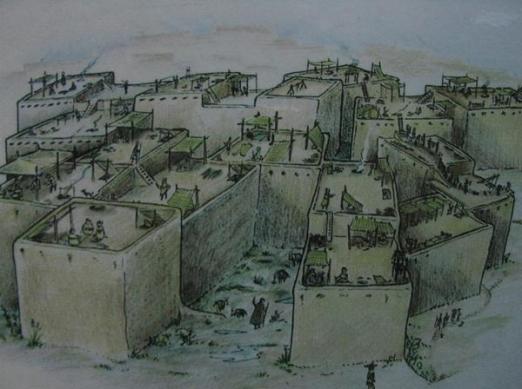
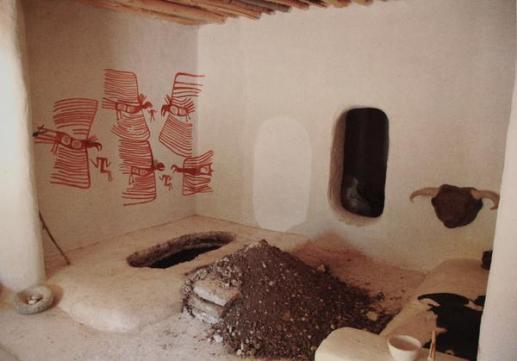
Gradually their simple, temporary shelters were replaced by more permanent mud brick and timber structures. That what they were doing was a whole new experience in DIY might be gathered from the ‘interesting’ design of their homes – windows and doors were yet to make an appearance! Access was through a hole in the flat roof using a type of ladder. Access and egress to the settlement was via external ladders and I guess that with ladders hauled up a sense of security was gained from the unknown things that go bump in the night and just might be lurking out there!
Çatalhöyük’s houses were built against each other and there were no streets or alleyways; perhaps the rooftops provided thoroughfares and ‘plazas’ for gatherings and work. The life of a house appears to have been around eighty years after which they were part demolished and a new house built on the site using the old as a foundation. Over the course of around 1500-2000 years the mound as we see it today grew up.
Çatalhöyük – reconstructed house used to test ideas and theories about life 9000 years ago
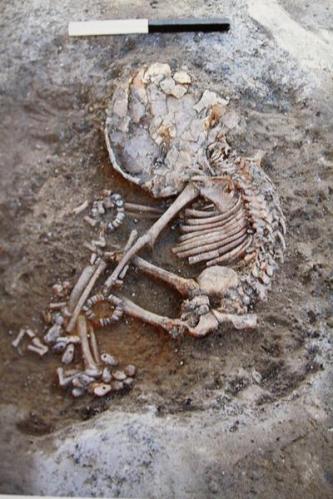
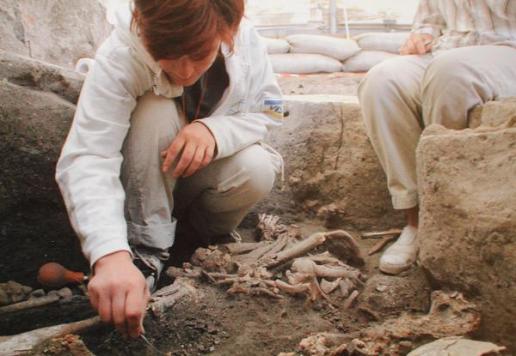
The dead were buried under the floor of the houses and covered by a small, flat raised mound which may also have been used for sleeping on. Why? No one knows. That the dead were respected is evident from the nature of the burials, particularly those of children.
Çatalhöyük – child burial, note bracelets and beads
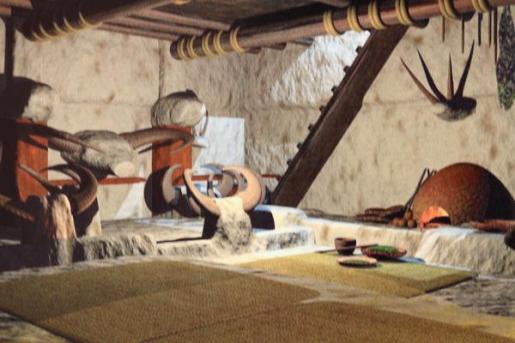
What are believed to be shrines of some sort have been excavated and effigies of bulls and bulls’ horns form an integral part of a religion of some sort.
digital reconstruction of a shrine
Art played a significant role in the lives of these people with houses decorated and elaborate figures sculpted, many in the form of a female. It was once believed that worship of the female or some Earth Goddess was prevalent but this has changed as excavations and research has opened up new avenues. Today it is believed that men and women ranked equally in status and the lack of ‘public buildings’ points towards a more ‘socialistic’ or communal way of life with full sharing of the fruits of the community’s labour the norm.
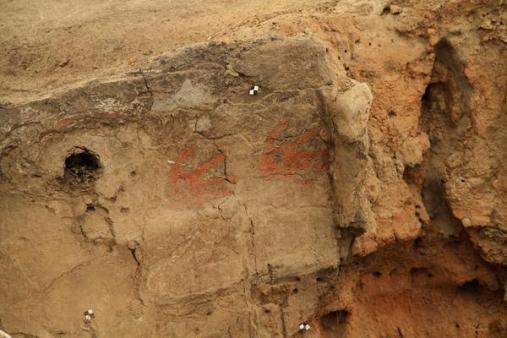
7000 year-old hand prints
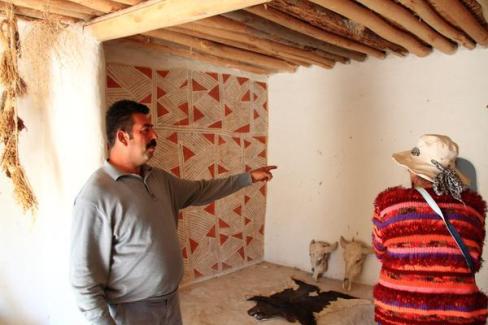
‘Enough of this history!’ I hear you say, so let me add a bit about our visit to Çatalhöyük. Excavations go on for about two and a half months each summer and, much as we would have liked to see this underway, there is no way J and I are going to do the ‘Mad Dogs and Englishmen (and women)’ bit! We prefer the cooler, tourist-free days, and so it was that we had the whole site to ourselves. There is no entrance fee and as nobody is allowed to wander the site unescorted we had our very own guardian/guide, Mustafa, to show us around – he was a mine of information and to make the most of him you would need reasonable Turkish.
J with our personal guardian/guide Mustafa
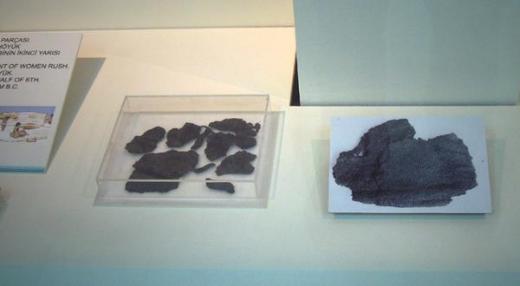
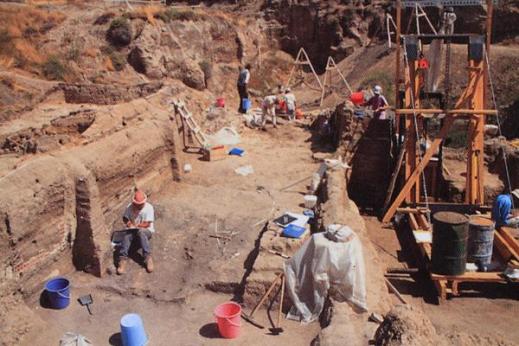
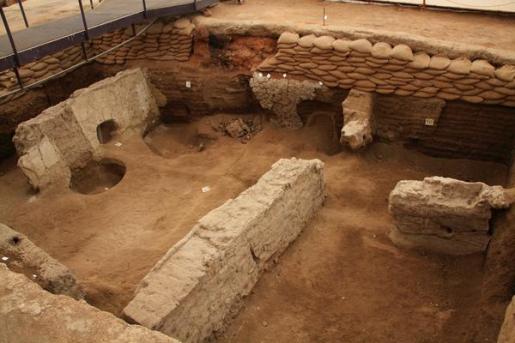
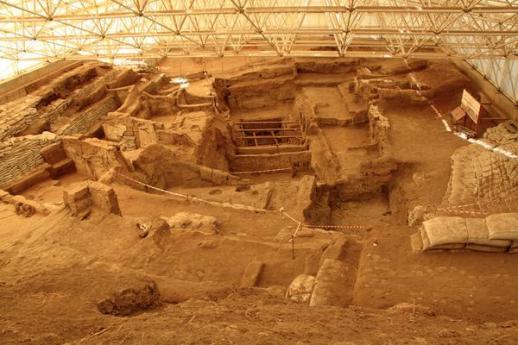
James Melaart discovered Çatalhöyük in 1958 and carried out excavations between 1961 and 1965 before controversy closed the dig down. In that time he uncovered a relatively huge area of some 160 buildings. Work began again in 1993 under the direction of Ian Hodder. In the 25 years between the methods and techniques of archaeology have developed hugely. Hodder and his multi-disciplinary team has taken 20 years to painstakingly excavate just a few houses. The results have opened up the Neolithic/Bronze Age world in astonishing detail. Finds from Çatalhöyük are so significant that the majority are housed in Ankara with just a few in Konya Archaeological Museum. What follows are a few photographic impressions – don’t let the apparent ‘sepia’ tint turn you off – you are looking at one of the oldest and best preserved ‘cities’ ever discovered. Let your imagination go walk-about.
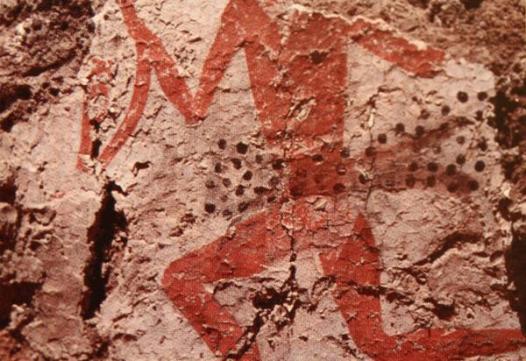
painstaking attention to detailearliest known fragments of clothMelaart’s earlier excavationsyour first glimpse of the excavations – at this level you are looking back 7000 years!excavations have continued at Melaart’s original dig – down to bed-rock through 18 levels (9000 years)decoration on the original plaster wall of a house
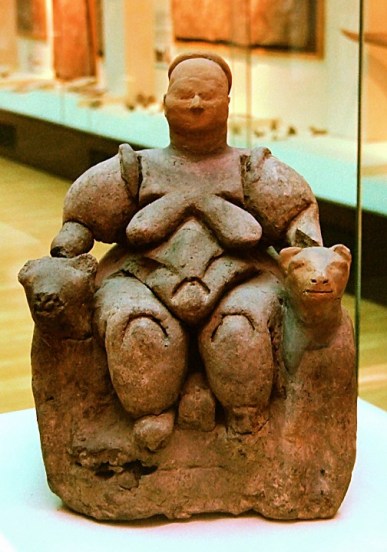
. . and finally, the figure that has come to symbolise everything that Çatalhöyük has come to represent . .
. . once thought to represent an Earth or Mother Goddess its meaning has been obscured by more recent studies. That said, nothing can take away the power of this figure from a lost world that is slowly emerging from the mists of time. A link to a recent Mail Online article about the world’s oldest painting.
Disclaimer: Every part of this story is true. You can choose to believe it or not – I know it is true because I was present when these things happened. (recovered from and first published on Archers of Okçular October 2013)
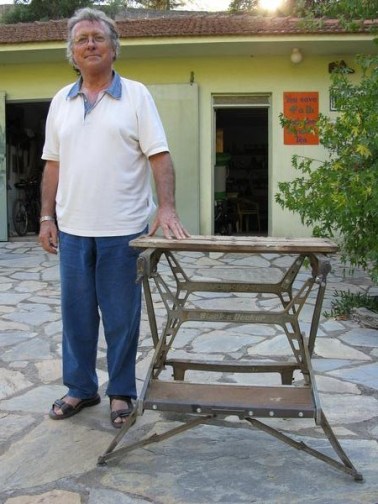
Last year an old workmate of mine suffered a catastrophic collapse and multiple fractures when we were doing a job together. Stanley ‘Blacken’ Decker and I teamed up forty odd years ago and we’ve collaborated on all sorts of DIY and home improvement jobs. Over the years we’ve bent every health and safety and common sense rule you can think of and got away with it. Our good luck ran out last year and I felt guilty as hell because I was the cause of what nearly killed ‘Blacken’. At the time I really thought that the injuries were terminal but, after nearly a year of rest and some brilliant surgery that included two transplants, SBD is back in ‘harness’.
When J and I moved to Turkey, ‘Blacken’ moved here too, arriving about three months after we did. It wasn’t long before we were up to our old tricks of pushing the limits of physics, engineering and good old plain common sense! Our luck held until last year when I’d given ‘Blacken’ the job of supporting a huge tree trunk whilst I set about reducing it to manageable pieces with a chain saw. It was an accident waiting to happen and what followed was horrifying. ‘Blacken’s’ spine broke near the top causing the huge trunk to topple down onto the lower limbs which were also smashed. ‘Blacken’ was shattered and the injuries looked terminal. The loss of an absolutely essential workmate and friend left me distraught and at a total loss.
To cut a long story short, and I know this makes me seem a bit heartless, I needed a replacement to help with all the jobs I wanted to do and so I began making enquiries. It was a fruitless search – there was no one here in Turkey who could help. In the end I had no other alternative than to persuade ‘Blacken’ to undergo re-constructive surgery with a view to coming back to work.
The results are pretty amazing – after that near-death experience old SBD will never be quite the same again but, as long as between us we use a bit of that rare commodity ‘common-sense’ and don’t overdo things in the way we used to, there is no reason why we can’t continue our collaboration for many more years.
‘Blacken’ – nearly as good as newhome-made handles – a successful transplantspinal tap and splintfractured foot board pinned and splintedme and my workmate ‘Blacken’ – back in business!
Alan in Okçular
ps There is twist to this tale. When I was a soldier stuck in some boring place or other me and my mates would send off letters to manufacturers of various products such as Mars Bars and Wilkinson Sword razor blades in which we eulogised the benefits to us poor Toms. You would be surprised how often this paid off and boxes of chokky-bars would arrive a couple of months later or, in the case of Wilkinson Sword, a letter containing a single razor blade and a note saying thanks for the endorsement and ‘please find enclosed a three months supply’. A few others had obviously tried that one!
Ever the optimist I have written to Messrs Stanley, Black and Decker at their head office in the US and enclosed some of the above photos. I have explained the unavailability of the latest Workmate here in Turkey despite it being on their website and in their catalogue. I have praised the stamina and durability of their old product after years of use and abuse and my disappointment at being unable to buy a replacement and having had to make repairs and carry on. I’m awaiting their response and I’m not holding my breath – meanwhile ‘Blacken’ and I have a few jobs to be getting on with!
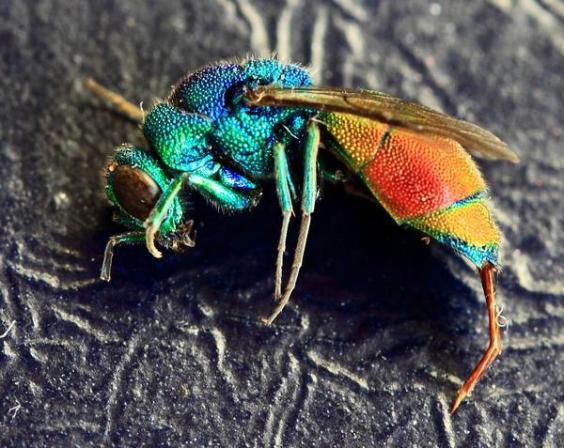
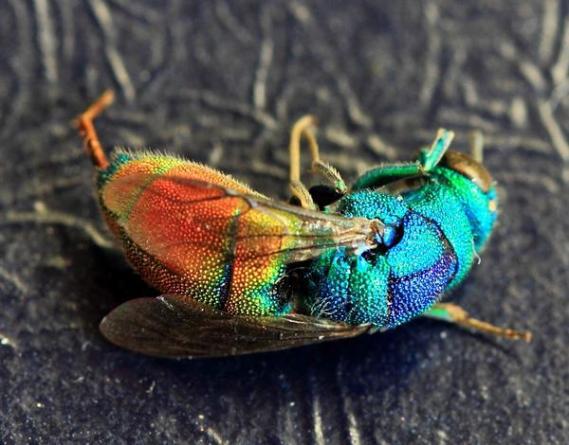
Cast your peepers over this little gem! Gem being the operative word for Chrysis angustula a species of Ruby-tailed Wasp. This particular one is found across much of Europe and we get to see a fair number of them here in Turkey – if we look carefully because they are pretty small at about a centimetre in length. Throw in the ‘stinger’ and you can add half as much again! Those of you in the UK who go looking will find C ignita which is a little less spectacular in colouring. This specimen was found bereft of life on the windowsill so was easy to photograph – just look at those amazing colours, almost enough to make you believe in ‘Intelligent Design’ if you didn’t know better!
yes, that really is its stinger
The glittering, metallic Ruby-tailed Wasp is one of many species of solitary bee and wasp that can be spotted in a variety of habitat from walls to sandy quarries, rocky outcrops to tree trunks. These insects do not live in colonies like Honey Bees; usually solitary females will build a nest by herself, stock it with pollen and lay an egg within each cell she has created. However, the adults of the Ruby-tailed Wasp are a little lazier: the females will actually open up a nest to check the size of the pupae inside. When satisfied with the plumpness of the victim they lay their eggs, one to each larvae. They usually choose the nests of other solitary bees and wasps, especially Mason Bees. When the eggs hatch, these larvae eat the larvae of the Mason Bees and develop – this gives the Ruby-tailed Wasp its other name of ‘Cuckoo Wasp’.
amazing, or what!
This stunning ‘armour-plating’ is thought to have evolved as protection in case they are caught in the act of infanticide/insecticide!
I would have liked to put up more photos but lack of bandwidth is frustrating me. As for the post title – ‘Ruby’ for the wasp; ‘Goodbye’ and ‘Tuesday’ for the fact that I tried to get this up yesterday (Tuesday) but was frustrated by the bandwidth thing and so had to kiss Tuesday goodbye! Seems perfectly logical to me and it’s good for the search engines!
“A certain man once lost a diamond cuff-link in the wide blue sea, and twenty years later, on the exact day, a Friday apparently, he was eating a large fish – but there was no diamond inside. That’s what I like about coincidence.”
― Vladimir Nabokov, Laughter in the Dark
(rescued from Archers of Okçular first posted October 2013)
J and I wandered off to İstanbul last Friday. We were going to meet up with saxophonist John Surmanwho was doing a solo gig at the İstanbul Jazz Festival – JS is family and we don’t get to meet up as often as we’d like. This time around his schedule was more relaxed than is usual with these things and we were able to go for some essential shopping around the musical instrument makers’ places of business at the top of Tünel for odds and sods and, perhaps, a new ‘toy’ or bit of serious gear.
First stop was for a zurna, that quintessential Middle Eastern horn, with its most distinctive sound. We’d stopped by a particular shop three or four years earlier with Jack Dejohnette‘s ‘Ripple Effect’ group and Brazilian multi-instrumentalist Marlui Miranda who had been delighted to get her hands on her very own zurna.
‘Ripple Effect’ Jack on drums, JS in reflection (2nd/3rd from r) Marlui extreme right (JazzItalia photo)
Moving on, we were looking for a particular type of reed for some obscure horn JS had acquired some years earlier – we found some in the atelier/atelye/workshop of a saz and kemençe maker Oktay Üst. Turns out that Oktay is not just a master craftsman in wood, he is also a maestro of the kemençe with an international reputation.
JS acquired a mey, Oktay launched into a mini-concert and there was hardly a dry eye in the house. Why? because people like Oktay are a dying breed – makers and players of musical instruments are being fast superseded by cheap, mass produced plastic and that should be worth a tear from any lover of artistry.
As an aside, it is amazing what happens when the craftsmen/sellers/shopkeepers realise that they are dealing with someone who can really play these things – rather than someone who wants a wall or table decoration. 30-40% discounts are given and extra reeds thrown in without being asked for. Before you get any ideas, you’ll need to know which end to blow into and demonstrate a bit more than the equivalent of ‘chopsticks’! Above left you can see a zurna, two meys, a kemençe and a cd all by Oktay.
JS and Oktay Üst – two Maestros
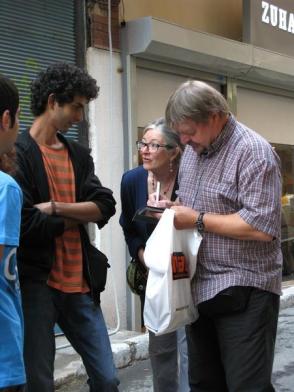
So, moving on. We had just left Oktay’s place when we were accosted by three young people who appeared to be trying to flog us a cd of some sort.
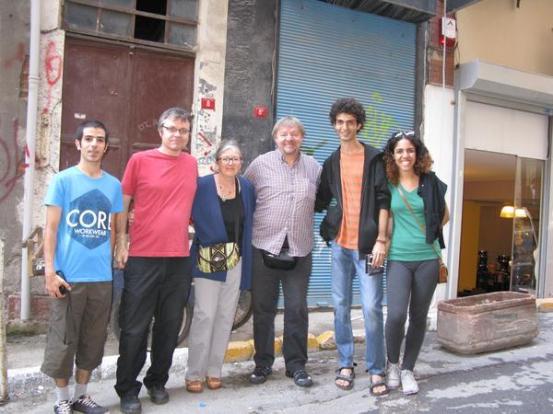
We could not have been more wrong – JS suddenly spotted that the cd they were ‘offering’ was one of his and an encounter and a coincidence came together. It turned out that these folks had come from Tehran, Iran for a visit to friends and specifically because their jazz idol John Surman was performing at the festival. They had bought their cd locally as they are not available back home and they just happened to be walking down this particular street as JS came out of Oktay’s place – a Close Encounter of the Coincidental Kind and a perfect chance to get an autograph!
We were able to enjoy a little time with them and then meet up later at the concert which, I have to say, was yet another virtuoso performance that ended with JS playing an encore of jazzed-up folk tunes whilst wandering around the auditorium. To those who don’t know John’s stuff I’d say ‘You really don’t know what you are missing’. His output over the years has been prolific and varied – from jazz to choral to brass to . . well, you name it. (his website is here) J and I are lucky enough to have several class musicians in the family, it means we get to be at some of the best gigs around, not only that, I can’t remember the last time we had to pay! How cool is that?
To finish off here are a few photos:
sound check with the mighty baritone saxJS, J, sound engineer Paul (in red) and the Tehran Fan Club
Finally, here’s maestro-usta Oktay Üst performing:





 Manrique aka
 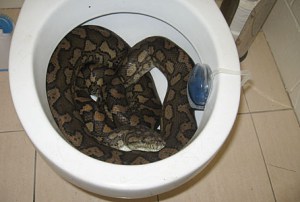 J and I are not just tolerant of having wildlife around, we positively encourage it – all of it! The odd snake in the toilet or under the washing machine does not result in panicky shrieking and rushing around in circles. (OK, we didn’t actually have a python in the toilet but there was a fair-sized black Whip Snake) That said, there was an occasion a few years back when I sat on a dozing hornet whilst getting into bed that resulted in all of the above plus some amazingly accurate usage of Anglo-Saxon expletives and a carpet slipper!
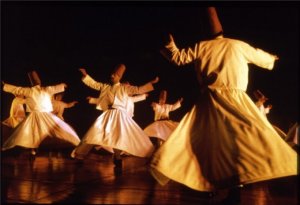 There’s a lot more to Konya than Whirling Dervishes, the Mevlana Museum and the haunting sound of the ney. Konya has been around for a while and in that time it has hosted everyone from Neolithic hunter-gatherers and Hittites, to various Greeks, Romans and Persians. And then the Seljuk Turks rolled in and had their day before getting rolled up by the marauding Mongol hordes around 1243.
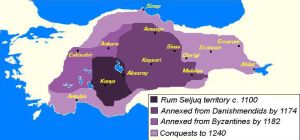 The Seljuk Sultanate of Rum (as in Rome and not Capt. Morgan) was a pretty successful set up in its day. Covering much of present day Anatolia it traded across the Mediterranean basin and Middle East. It was powerful and wealthy enough to battle the Crusaders and foster art and architecture on the grand scale and Konya was its principle city for much of its existence.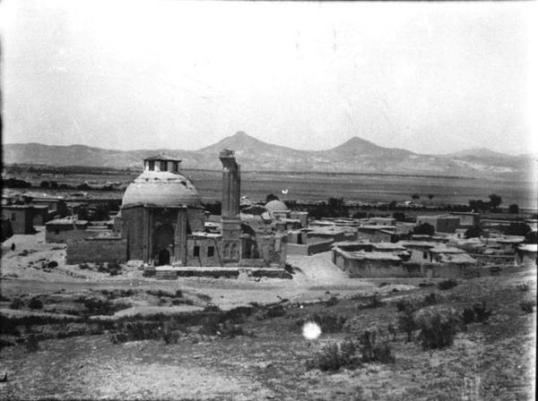

 J and I went off wandering again this past week – the Prime Directive was to visit Çatalhöyük near Konya and then tuck in a few other goodies as time and circumstance allowed. We both thought that the on-going excavation of this astonishing Bronze Age settlement was brilliant. I, for one, was fired up and set about trying to transfer that fire into a blog post that just might convey something of what we had seen. I was minutes away from posting when everything vanished; text, photos – the lot. There was nothing on the server where you would have expected the last auto-save to be and the auto back-up on my computer was blank! I have never experienced anything like it. Disheartened was not the word!
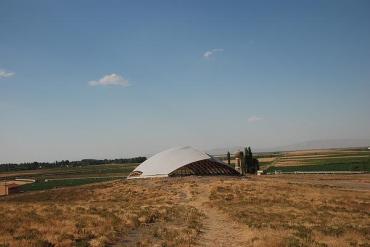 Picture, if you can, the vast flatlands of central Anatolia, dry and brown after the burning heat of summer. This land is the ‘breadbasket’ of Turkey, in some ways similar to the North American prairie or the steppes of Ukraine. Out of this flatness a mound some 21 metres high rises, topped by two alien structures – this is Çatalhöyük, the site of one the oldest human settlements yet discovered.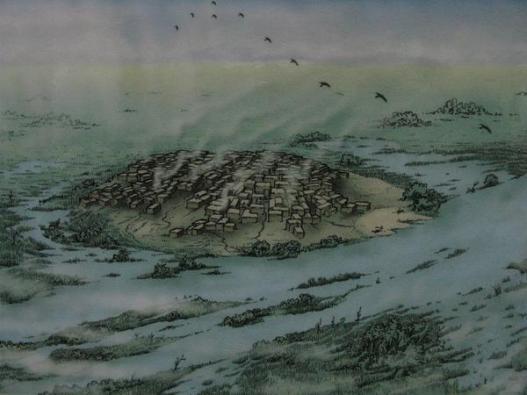
 Last year an old workmate of mine suffered a catastrophic collapse and multiple fractures when we were doing a job together. Stanley ‘Blacken’ Decker and I teamed up forty odd years ago and we’ve collaborated on all sorts of DIY and home improvement jobs. Over the years we’ve bent every health and safety and common sense rule you can think of and got away with it. Our good luck ran out last year and I felt guilty as hell because I was the cause of what nearly killed ‘Blacken’. At the time I really thought that the injuries were terminal but, after nearly a year of rest and some brilliant surgery that included two transplants, SBD is back in ‘harness’.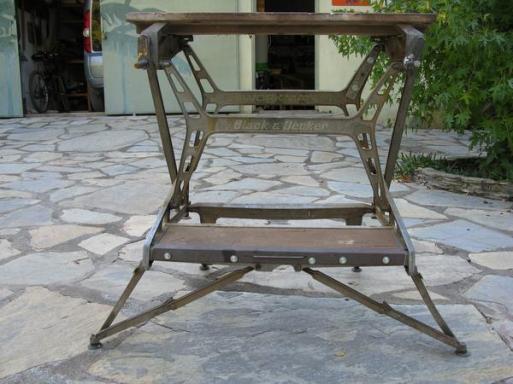


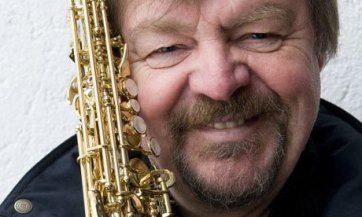 J and I wandered off to İstanbul last Friday. We were going to meet up with saxophonist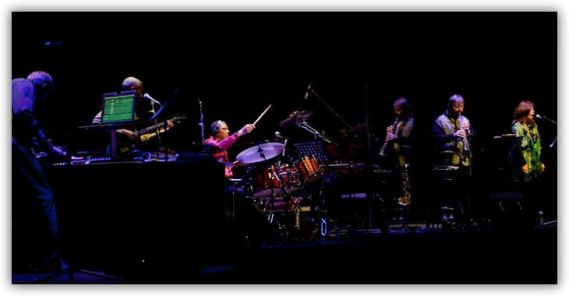
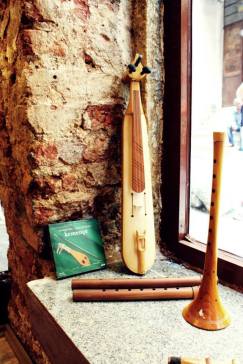 JS acquired a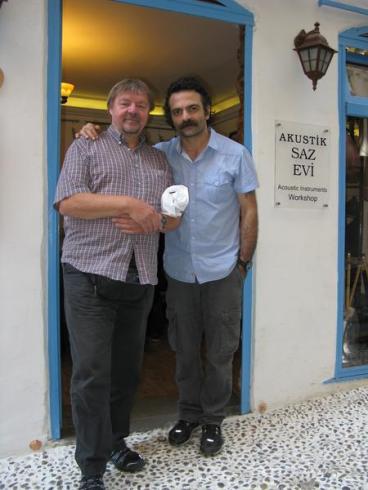
 We could not have been more wrong – JS suddenly spotted that the cd they were ‘offering’ was one of his and an encounter and a coincidence came together. It turned out that these folks had come from Tehran, Iran for a visit to friends and specifically because their jazz idol John Surman was performing at the festival. They had bought their cd locally as they are not available back home and they just happened to be walking down this particular street as JS came out of Oktay’s place – a Close Encounter of the Coincidental Kind and a perfect chance to get an autograph!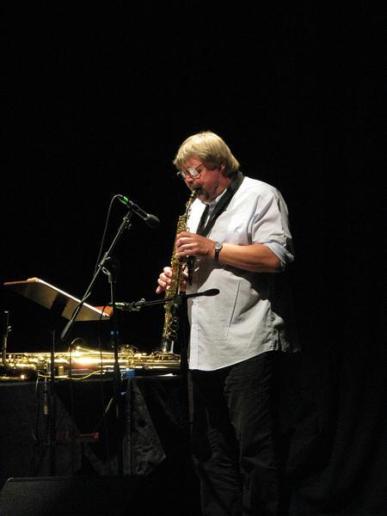

 Bof's Blog